


Everything began in the late 19th century in the United States. Men worked hard—miners, laborers, gold prospectors—and they needed clothing capable of withstanding dust, sweat, and the passage of time. This is how the jean was born: a sturdy pair of trousers, designed to last.
But this story is not exclusively American. In France, in the city of Nîmes, a specific fabric was being manufactured—a resistant cloth, dyed with indigo, called "toile de Nîmes." Over time, it transformed to become "denim."
Two continents, one single material, one same idea: to create a garment that resists.
Jeans become a symbol
The years went by, and jeans left the construction sites. They entered the cities, then the culture. In the 1950s, they became the clothing of rebels, popularized by figures like James Dean. They embodied freedom, a way of saying no to established rules.
Woodstock: jeans and peace
Woodstock was born in 1969 in the United States. The festival was held in Bethel, on a farm, and brought together more than 400,000 people around music and peace. A generation refused the Vietnam War, rejected violence, and chose peace. Jeans accompanied this peace and love generation.
On stage, Joe Cocker. In the crowd, people danced in jeans, in the mud, in freedom. Denim mini-skirts, denim bell-bottoms—conservative America was shaken. Jeans were more than a fashion; they were a mode of expression.
In France, jeans are a means of emancipation for women.
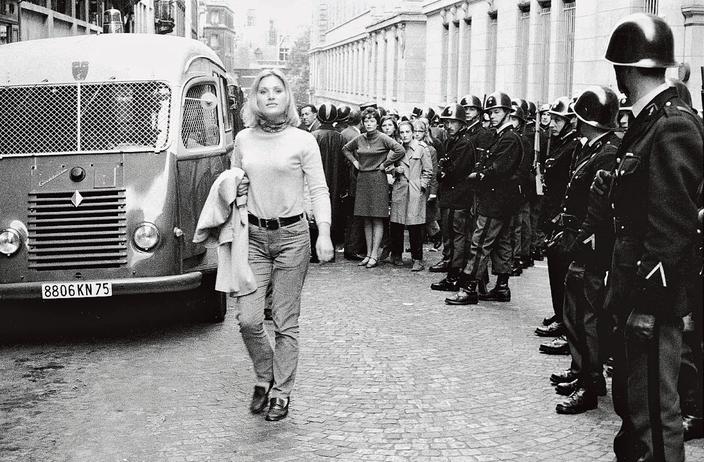
French jeans are stylish but defiant. In France, in 1968, a revolution broke out, also for women, and it was in jeans.
May '68 was students and workers taking to the streets, challenging authority, rules, and society. It was a period of profound questioning, where mindsets changed.
Women took their place, asserted themselves, and jeans became the visible symbol of this freedom. Denim mini-skirts no longer hid women's bodies; they expressed their status, they worked, they were now free.
Jeans established themselves; they expressed women's freedom with May '68.
The baggy jean
Born in the United States, the baggy jean found its origins in the streets of New York, and more particularly in Harlem.
It was popularized in the 80s and 90s by hip-hop culture and artists like Tupac Shakur.
This style became a symbol of urban identity. In the 2000s, it sparked controversy, particularly surrounding “sagging.”
Today, it is back in fashion, worn for its comfort and its aesthetic inspired by the 90s.

In Paris, at the Saint-Ouen flea market. That is where it all began for JAMYAS.
An authentic, vibrant place. A mix of styles, eras, cultures, and social backgrounds. At the flea market, jeans are not just sold, they are lived. There is a Parisian, French, yet international atmosphere with a special energy that gives jeans a different soul.

John Lennon and Yoko at the Saint Ouen flea market, France
The story of JAMYAS jeans
The story of JAMYAS jeans does not start with a brand. It starts with experimentation.
In the late 80s, early 90s, I was a student working weekends at the flea market. Then I worked for a company during the week, and on weekends, I was at the flea market.
Two lives in parallel, and finally, I decided to make it my profession. I started with vintage and new items. I bought, I resold, I observed. I understood cuts, materials, what people really liked.
At the same time, I started manufacturing in the Sentier district, a few pieces here and there, with what I could find. End-of-stock fabrics, leftovers.
I created my first raw denim jeans. At that time, brands like Levi’s or Lois were already very present. The market was established. It was also then that the first eco-responsible jeans began, particularly the eco-responsible baggy, and without us knowing it, for us it was obvious.
There were several attempts at brand names before finalizing the JAMYAS jeans.
Then came the wave of jeans made in Asia. I then created a workshop in Tunisia, specializing in jeans.
Doing things differently and simply
With JAMYAS, we don't do things like the others. We work exclusively from end-of-stock fabrics. Materials already existing, already produced, but often unused.
We gave a second life to fabrics. We were the first in France to work this way. Thus were born the eco-responsible jeans, the JAMYAS jeans.
Our Jamyas jeans are mainly cotton, sometimes with a touch of elastane, never more than 2%, for comfort, without sacrificing quality.
Producing with consistency
I manufacture in France and around the Mediterranean rim; it’s a logical choice.
Because cotton often comes from these regions.
Because proximity allows for oversight.
Because producing nearby is producing better.
Because the carbon footprint is ultra-reduced.
I want a sturdy, durable pair of jeans, designed to withstand time.
Between tradition and modernity
I respect jeans, I love jeans: the more they age, the more beautiful they are, provided they are quality denim.
I work on the basics: the straight cut, the five pockets, the raw denim.
But I also bring a bolder touch, inspired by the street and what I see every day.
Because jeans must live with their era.
A story built over time
An antecedence that makes JAMYAS the first eco-responsible French brand.
There have been reports:
-
M6 in 2007
-
France Inter in 2009
Jamyas jeans were born in the street, on the stalls of the Saint Ouen flea market.
Today
One pair of jeans is sold per inhabitant per year.
But behind this success, a question arises: how to reduce all forms of pollution without sacrificing the style, passion, and freedom that jeans carry? We are working on it with passion, making our modest contribution.
Do less, do better, make more beautiful.

